
Our Beetles
*
Our Beetles *
-
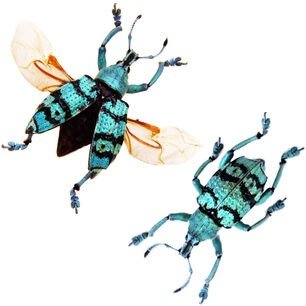
Eupholus Chevrolati
Eupholus chevrolati is a beautiful species of weevil belonging to the family Curculionidae.
Appearance: This is a relatively small Eupholus species, reaching lengths of about 25 millimeters (0.98 inches). Its base color is a striking metallic blue-green, adorned with irregular black transverse bands along its wing covers (elytra). This vibrant blue-green coloration comes from very small scales covering its body. The tip of its snout (rostrum) and the end of its antennae are black.
Habitat: Eupholus chevrolati is found in the Aru Islands of Indonesia, located southwest of New Guinea. -
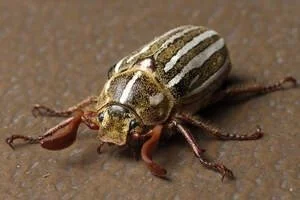
Polyphylla
This is a genus of scarab beetles, often referred to as chafers or June beetles, though they are distinct from the Phyllophaga genus which is more commonly called June beetles in North America. Polyphylla beetles are generally larger and often have distinctive antennae, especially in the males.
Appearance: Polyphylla beetles are typically robust and oval-shaped. They are often brown or reddish-brown in color, and some species have patterns of white or yellowish scales on their elytra (wing covers). A key characteristic of this genus is the lamellate antennae, which are fan-like or comb-like at the tip, particularly prominent in males. These antennae are thought to help them detect the pheromones released by females.
Habitat: Polyphylla beetles have a wide distribution across the Northern Hemisphere, including North America, Europe and Asia. -
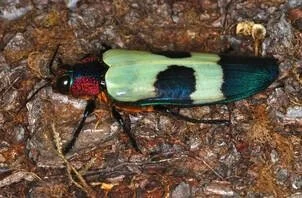
Chrysochroa Buqueti
Chrysochroa buqueti, also known as the red speckled jewel beetle, is a species belonging to the Buprestidae family (jewel beetles).
Appearance: These beetles are relatively large, reaching lengths of about 40–47 millimeters (1.6–1.9 inches). They exhibit vibrant metallic colors.
Habitat: It is a Southeast Asian species. It can be found in countries such Malaysia, Borneo and Thailand. -
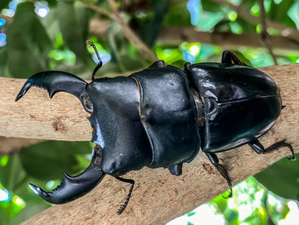
Dorcus Titanus Yasuokai
It's a subspecies of the stag beetle Dorcus titanus, commonly known as the giant stag beetle.
Appearance: Males can reach impressive sizes, ranging from approximately 40 to 105 millimeters in length. They have a heavy and powerful black body with elongated, curved mandibles (jaws) that resemble the antlers of a stag, which are particularly prominent in males.
Habitat: This subspecies is found in Indonesia, specifically in Sumatra. -
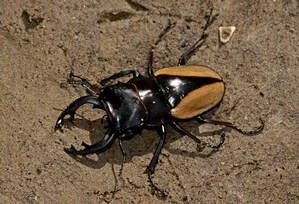
Odontolabis Lacordairei
Commonly known as Lacordaire's stag beetle, is a striking species belonging to the family Lucanidae.
Appearance: They are characterized by their robust, dark bodies and, particularly in males, impressive, elongated mandibles. The elytra (wing coverings) often exhibit a pale yellowish-brown coloration, sometimes with additional brown patches. The head, thorax, and legs are typically black. Adult males can reach lengths of approximately 4 to 6 centimeters (40-60 mm), sometimes slightly larger.
Habitat: It is native to Southeast Asia, with a presence in countries like Thailand, Malaysia, and Indonesia (specifically Sumatra and Borneo). -
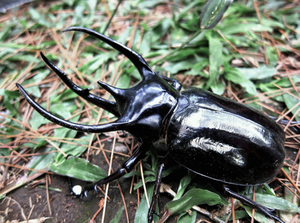
Chalcosoma Caucasus
The currently accepted scientific name for this species is Chalcosoma chiron. It's often referred to as the Caucasus beetle.
Appearance: Males are easily recognized by their three prominent horns: one on the head and two on the thorax. These horns are used in fights with other males for mating rights. Males can reach a length of 90–130 mm (3.5–5.1 inches), making them the largest in the Chalcosoma genus and one of Asia's largest beetles. Females are black and significantly smaller, with a velvety texture on their elytra (wing coverings) due to tiny hairs.
Habitat: This beetle is found throughout Southeast Asia, including Malaysia, Indonesia (Sumatra, Java), Malay Peninsula, Indochina and Thailand (East region). -
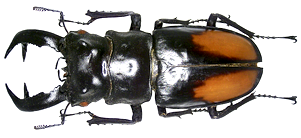
Hexarthrius Paradoxus
It's a stag beetle, also known as the Sumatran Fighting Giant Stag Beetle.
Appearance: Males can reach impressive lengths of 70-97 millimeters (around 2.8-3.8 inches), measured from the tip of their mandibles to the end of their elytra (wing coverings). Females are smaller, typically ranging from 40-54 millimeters (1.6-2.1 inches).
Habitat: It is found specifically in Sumatra, Indonesia. -
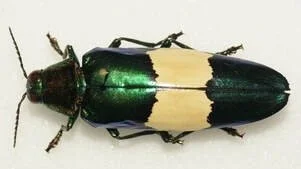
Chrysochroa Saundersi
They are a beautiful species of jewel beetle belonging to the family Buprestidae.
Appearance: They are highly prized for their vibrant metallic coloration, often displaying brilliant shades of green and yellow on their elytra (wing coverings). Adult Chrysochroa saundersi can reach a body length of approximately 3-5 centimeters (1.2-2 inches).
Distribution: It is found in Southeast Asia, particularly in countries like Thailand and Malaysia. The genus Chrysochroa as a whole has a wider distribution across Southeast Asia, including Indonesia and the Philippines, with some species found in India, Japan, Korea, and even Africa. -
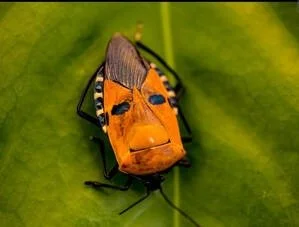
Catacanthus Incarnatus
This is a species of shield bug or stink bug, belonging to the family Pentatomidae. They are known for their vibrant colors and relatively large size.
Appearance: They are quite distinctive in appearance, characterized by their bright and contrasting colors. The base color is often a vibrant red or orange, with prominent metallic blue or green markings on the pronotum (the shield-like plate behind the head) and the scutellum (the triangular plate in the middle of the back). The pattern and intensity of these colors can vary slightly between individuals. Their legs and antennae are typically black. These are relatively large shield bugs, with adults typically reaching lengths of 2.5 to 3.5 centimeters (about 1 to 1.4 inches).
Habitat: Is found in Southeast Asia, including countries like India, Sri Lanka, Myanmar, Thailand, Malaysia, Singapore, Indonesia, the Philippines, and Papua New Guinea. Its distribution is quite widespread across the region. -
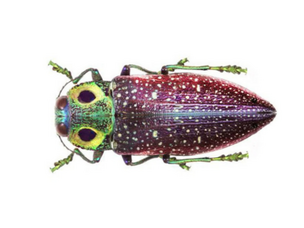
Lampropelpa Rothschildi
It's often called the Madagascar Jewel Beetle. Sometimes it's also referred to as the False Yellow-Eyed Beetle or the Green Purple Owl Eye Beetle due to its distinctive markings.
Appearance: This is a strikingly beautiful beetle with a metallic sheen, often displaying red with green and purple highlights. A key feature is a set of false yellow "eyes" on its body, in addition to its real eyes. Adult beetles can reach a significant size, with one mention of a specimen measuring 45 mm (almost 2 inches) in length.
Habitat: As the name suggests, Lampropelpa rothschildi is endemic to Madagascar. Records indicate it's found in the southern regions of the island. -
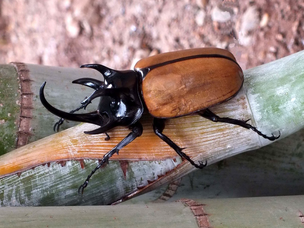
Eupatorus Gracilicornis
Also known as the five-horned rhinoceros beetle, is a remarkable species belonging to the family Scarabaeidae and the subfamily Dynastinae (rhinoceros beetles). It's quite distinctive due to the presence of four large horns on its prothorax and an exceptionally long cephalic (head) horn in males.
Appearance: Their bodies are typically a shiny jet-black, while their elytra (forewings) are often a contrasting yellow or gold color. Like other rhinoceros beetles, they have a thick exoskeleton and sturdy wing covers that protect a set of membranous wings used for flight, although they are not particularly efficient fliers due to their size. Males are significantly larger than females, ranging in length from 50 to 95 millimeters (approximately 2 to 3.7 inches).
Habitat: It can be found in several Southeast Asian countries, including China, India (Assam), Myanmar, Thailand, Laos and Vietnam. -
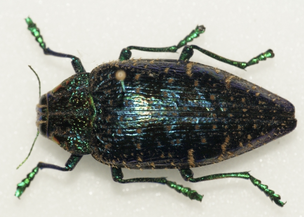
Polybothris Sumptuosa
This is a species of jewel beetle, belonging to the family Buprestidae. The name itself, "sumptuosa," hints at its magnificent appearance.
Appearance: They are celebrated for their incredibly vibrant and intricate coloration. Their elytra (wing coverings) are typically a brilliant metallic green or bluish-green, adorned with striking patterns of red, orange, or gold. These patterns can vary somewhat between individuals but often take the form of bands, spots, or reticulations, creating a truly jewel-like appearance. Adult beetles can reach a significant size for jewel beetles, ranging from approximately 4 to 6 centimeters (around 1.6 to 2.4 inches) in length.
Habitat: Polybothris sumptuosa is found in the tropical rainforests of Madagascar. -
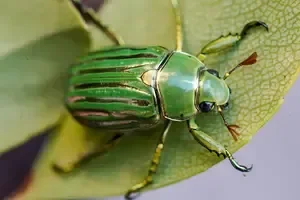
Chrysina Gloriosa
It’s commonly known as the glorious beetle or glorious scarab.
Appearance: The Chrysina gloriosa is renowned for its striking metallic coloration. The elytra (wing coverings) are usually a bright, shiny green with distinct silver stripes running along them. Rarely, color variations with red or purple hues can occur. This iridescence is due to the unique microscopic structure of their cuticle, which contains cholesteric liquid crystals of chitin molecules that reflect light in specific ways. Adult beetles are typically 20 to 30 millimeters (0.8 to 1.2 inches) in length. Females tend to be slightly larger than males.
Habitat: This species is found in the southwestern United States (southeastern Arizona, southern New Mexico, and southwestern Texas) and northern Mexico (Chihuahua and Sonora). -
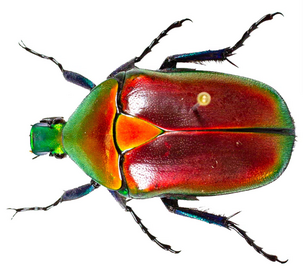
Torynorrhina Flammea (Red form)
It’s a species of flower beetle or fruit chafer belonging to the family Scarabaeidae and the subfamily Cetoniinae. It's known for its vibrant colors and is quite variable in its appearance.
Appearance: While the name "flammea" suggests a fiery red, they can also be found in stunning shades of cobalt blue, emerald green, scarlet red and various combinations of these colors. Adults can reach a body length of approximately 30 to 35 millimeters (1.2 to 1.4 inches). Females tend to have wider forelegs compared to males.
Habitat: This species is found in Southeast Asia, including, Thailand, Assam (India), Malaysia and China. -
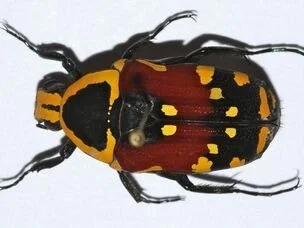
Euchroea Aurostellata
It’s a species of scarab beetle belonging to the family Scarabaeidae and the subfamily Cetoniinae (flower chafers).
Appearance: Euchroea aurostellata is admired for its striking coloration. The elytra (wing coverings) are typically a bright redish-orange to wine red with a pattern of yellow or golden spots or an outline. hey are relatively small beetles, with adults typically measuring around 2-3 centimeters (approximately 0.8-1.2 inches) in length.
Habitat: They are generally found in the forested regions of Madagascar, where the adults likely feed on flowers or fruits. -
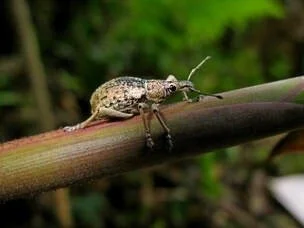
Rhinoscapha Dorhni
It’s a species of weevil belonging to the family Brentidae, subfamily Eurhynchinae (sometimes treated as a separate family Eurhynchidae). These weevils are known for their elongated rostra (snouts) and often striking patterns.
Appearance: Rhinoscapha dorhni is characterized by its Elongated rostrum, a long snout that is used for feeding and laying eggs. They exhibit beautiful patterns of black, white, yellow, orange, or red scales on their elytra (wing coverings) and body. They have a sturdy build, typical of many weevils. These are relatively large weevils, with the body length (excluding the rostrum) often ranging from 2 to 4 centimeters (approximately 0.8 to 1.6 inches). The rostrum itself can add significant length, especially in females.
Habitat: This species is found in Indonesia, specifically in the region of Papua (formerly Irian Jaya). -
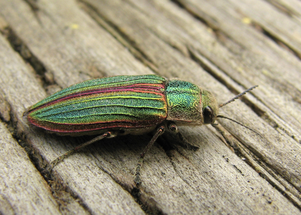
Buprestis Aurulenta
Commonly known as the golden jewel beetle or golden buprestid, is a striking beetle with an iridescent golden-green body and orange trim along its wing covers.
Appearance: The adult beetle is about ¾ inch long and has a flattened, boat-shaped body. The larvae are whitish, about 1-1/2 inches long when fully grown, and are known as "flatheaded borers" due to their widened thoracic segments behind the head.
Habitat: This beetle is native to North America, primarily found in the Pacific Northwest, ranging from southern British Columbia south through the Rocky Mountains to Mexico. It is less common in Alberta and has been found in Manitoba. -
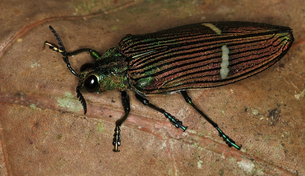
Catoxantha Opulenta
Also known as the opulent jewel beetle or green-banded jewel beetle, is another beautiful member of the Buprestidae family.
Appearance: This is a relatively large jewel beetle, with adults reaching lengths between 45 and 60 millimeters (1.8 to 2.4 inches). It boasts a striking metallic dark bluish-green color on its wing covers (elytra), which are adorned with thick, prominent black longitudinal ridges (costae) and two distinctive yellow transverse bands. The underside of the beetle (abdominal sternum) is yellow.
Habitat: Catoxantha opulenta is found in Southeast Asia, specifically in Thailand , Malaysia, Western Indonesia and Philippines. -
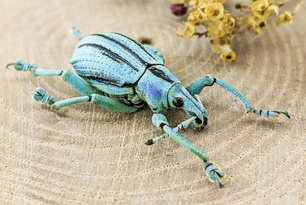
Eupholus Cutieri
It’s a vibrant species of weevil belonging to the family Curculionidae. These beetles are highly prized for their striking colors and are part of the Eupholus genus, which contains some of the most colorful weevils in the world.
Appearance: Eupholus cutieri is characterized by its beautiful blue-green body. While specific details about patterns or size variations within the species can differ, the overall coloration is a key identifying feature. Like other Eupholus weevils, it likely has a robust body and the characteristic elongated snout (rostrum) typical of weevils.
Habitat and Distribution: This species is native to Indonesia. -
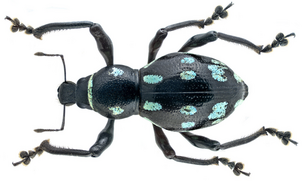
Metapocyrtus Elegans
It’s a species of weevil belonging to the family Curculionidae.
Appearance: As the name elegans suggests, this is likely a visually appealing weevil, though specific details about its coloration and patterns aren't readily available in the immediate search results. However, the genus Metapocyrtus is known for containing many colorful and patterned species. They are typically flightless weevils with a robust build and the characteristic weevil snout.
Habitat: Metapocyrtus elegans is found in the Philippines. -
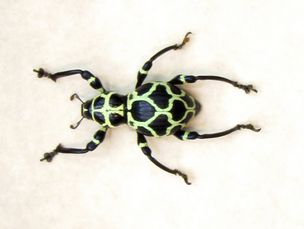
Pachyrhynchus Cruciatus
It’s a species of weevil belonging to the family Curculionidae.
Appearance: Pachyrhynchus weevils are often called "Easter egg weevils" due to their typically bright and intricate patterns. This genus is known for having various species with vivid colors and patterns formed by structural coloration in their scales.
Habitat: Pachyrhynchus cruciatus is found in the Philippines. -
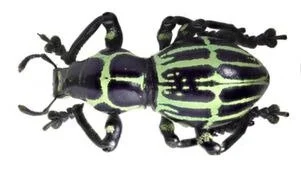
Pachyrhynchus Elenae
They are know by the nick name of "Easter egg weevils”.
Appearance: Pachyrhynchus weevils are renowned for their striking and often intricate color patterns formed by structural coloration in their scales and can come in various combinations of colors like green, blue, yellow, orange, red, and black. They are flightless weevils with a robust body and fused wing covers (elytra). Adults typically range in size around ¾ inch (14-15mm).
Habitat: The Pachyrhynchus genus is primarily found in Southeast Asian islands, with the highest diversity in the Philippines. These weevils are typically associated with tropical forest environments. -
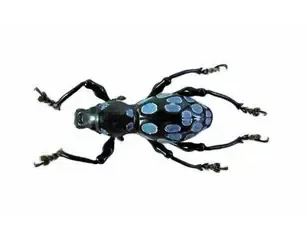
Pachyrhynchus Robustus
It’s a species of weevil belonging to the genus Pachyrhynchus.
Appearance: As with other members of its genus, Pachyrhynchus robustus are very colorful and patterned. The name "robustus" indicates that have a more heavily built than other species within the genus. They exhibit bright colors and intricate patterns formed by structural coloration in its scales. These patterns can include combinations of colors such as green, blue, yellow, orange, red, and black.
Habitat: Pachyrhynchus robustus is found in the Philippines. -
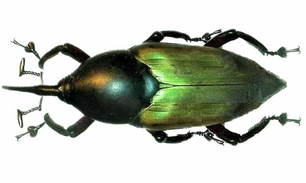
Paratasis Elegans
It’s a species of longhorn beetle (family Cerambycidae).
Appearance: While detailed descriptions of its coloration and patterns aren't readily available in the immediate search results, longhorn beetles in general are known for their often striking appearances and exceptionally long antennae, which can sometimes be longer than their body.
Habitat: Paratasis elegans is found in Madagascar. -
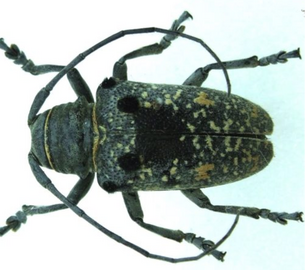
Megalofrea Bioculata
It’s a species of longhorn beetle belonging to the family Cerambycidae and the subfamily Lamiinae (flat-faced longhorned beetles).
Appearance: The genus Megalofrea generally contains relatively large and often strikingly patterned beetles. The adult beetle shows a dark body with lighter, possibly yellowish or greenish, irregular markings and two prominent dark spots (ocelli-like) on the pronotum, which likely contribute to the species name "bioculata" (meaning "two-eyed").
Habitat: Megalofrea bioculata is endemic to Madagascar. -
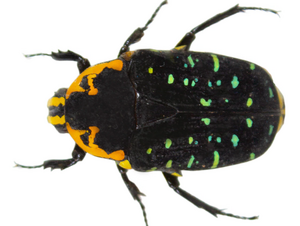
Euchroea Ripheus
This beetle is often referred to as the Madagascan jewel scarab or the rainbow scarab. Its iridescent colors are absolutely breathtaking.
Appearance: Euchroea ripheus is renowned for its brilliant metallic colors. Its elytra (wing covers) display a stunning array of iridescent hues that can include emerald green, sapphire blue, ruby red, amethyst purple and golden yellow.
These colors often shift and shimmer depending on the angle of light, giving it a truly jewel-like appearance. The beetle has a robust, oval body shape typical of scarabs.
Habitat: As the name "Madagascan jewel scarab" suggests, this species is endemic to Madagascar and is found in the rainforests and humid woodlands. -
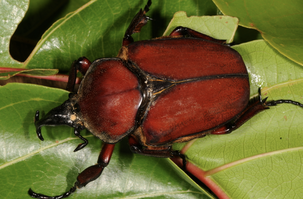
Fornasinius Russus
This beetle belongs to the scarab beetle family (Scarabaeidae) and the subfamily Cetoniinae (flower chafers). They are known for their often large size and striking colors.
Appearance: Fornasinius russus is a large and robust beetle. The term "russus" in Latin means "reddish" or "rusty," so it's likely that this species has a predominantly reddish-brown or coppery coloration. However, like many flower chafers, it might also have some variations in color or markings. Male Fornasinius beetles are known for having prominent horns on their heads and/or thoraxes, which they use in battles for mates.
Habitat: Fornasinius russus is found across various regions of tropical Africa. -
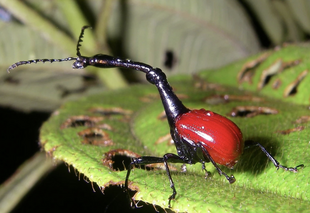
Trachelophorus Giraffa
This beetle is know by its common name of giraffe weevil, perfectly describes its most striking feature.
Appearance: The most distinctive characteristic of the Trachelophorus giraffa is the enormously elongated neck of the male. This neck can be two to three times the length of its body. The females also have an elongated neck, but it is significantly shorter than that of the males. The body of the weevil is typically black or dark reddish-brown, and the elytra (wing covers) are often reddish with black spots or stripes. This color contrast further accentuates the impressive neck.
Habitat: The giraffe weevil is endemic to Madagascar and is found in the humid rainforests of the southeastern part of the island. -
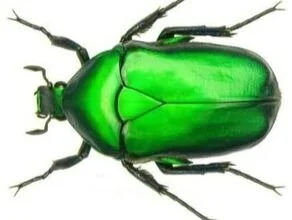
Torynorrhina Flammea (Green form)
It’s a species of flower beetle or fruit chafer belonging to the family Scarabaeidae and the subfamily Cetoniinae. It's known for its vibrant colors and is quite variable in its appearance.
Appearance: While the name "flammea" suggests a fiery red, they can also be found in stunning shades of cobalt blue, emerald green, scarlet red and various combinations of these colors. Adults can reach a body length of approximately 30 to 35 millimeters (1.2 to 1.4 inches). Females tend to have wider forelegs compared to males.
Habitat: This species is found in Southeast Asia, including, Thailand, Assam (India), Malaysia and China. -
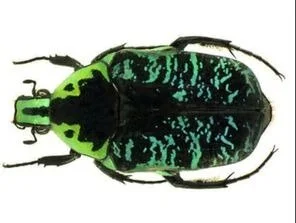
Euchroea Coelestis
It is a species of flower beetle in the family Scarabaeidae and subfamily Cetoniinae. It is highly prized by collectors for its vivid, iridescent coloration and unique markings.
Appearance: The beetle reaches an average length of 26–33 mm (approx. 1–1.3 inches). While its base color is black, its exoskeleton features a striking iridescent shine that shifts between electric blue, neon green, and glossy emerald depending on the light. Some specimens, particularly the subspecies peyrierasi, may feature "false eyes" on the rear as a defense mechanism to deter predators.
Habitat: Endemic to the rainforests of Madagascar. -
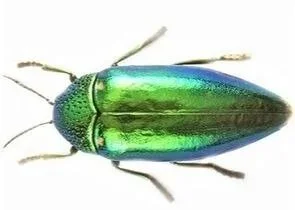
Sternocera Aequisignata (Green form)
It is a species of metallic wood-boring beetle in the family Buprestidae, commonly known as a jewel beetle.
Appearance: It is renowned for its brilliant, iridescent emerald-green exoskeleton. The elytra (wing covers) and pronotum (thorax) exhibit a striking metallic green shimmer. This iridescence is structural, caused by microscopic textures in the cuticle that reflect light, rather than pigments.
Habitat: Native to tropical regions of Southeast Asia, particularly Thailand, Myanmar, and Laos.